what is half of 3/4th cup explained simply for perfect cooking
Table of Contents
- Understanding the Fraction: A Breakdown of 3/4 Cup
- Mathematical Foundation of 3/4 Cup
- Visual Representation and Volume Comparison
- Representation in Kitchen Measurement Tools
- Dividing 3/4 Cup into Smaller Fractions
- Real-World Volume Comparisons
- Historical Context of Fractional Measurements in Cooking
- Common Misconceptions and Corrections
- Mastering Precision: Three Mathematical Methods to Calculate Half of 3/4 Cup
- Fraction Multiplication: Halving 3/4 Cup Using Basic Arithmetic
- Decimal Conversion: Converting and Halving 3/4 Cup Using Decimals
- Visual Division: Splitting a 3/4 Cup Illustration into Two Equal Parts
- Measuring Half of 3/4 Cup Using Only a 1/4 Cup Measure
- Comparative Analysis: Half of 3/4 Cup vs. Other Common Baking Fractions
- Practical Applications: Recipes and Cooking Scenarios Where Halving 3/4 Cup Transforms Culinary Outcomes
- Five Recipes Where 3/4 Cup Is a Key Ingredient and How Halving It Affects Results
- Side-by-Side Comparison: Full Recipe vs. Halved Recipe Adjustments
- Adjusting Ingredient Ratios When Halving 3/4 Cup: Liquid vs. Dry Ingredients
- Tools and Techniques for Accurate Measurement of 3/4 Cup and Its Half
- Comparison of Five Common Kitchen Tools for Measuring 3/4 Cup and Its Half
- Calibrating Improvised Tools for Measuring 3/4 Cup and Its Half
- Troubleshooting Common Measurement Errors
- Advanced Techniques for Professional Precision
- Household Items for Approximating 3/4 Cup and Its Half
- Common Mistakes and How to Avoid Them in Measuring 3/4 Cup and Its Half
- Five Frequent Errors in Measuring 3/4 Cup and Corrective Strategies
- Psychology of Measurement Errors: Why Precision Fails and How to Retrain
- Advanced Uses: The Science and Mathematics Behind 3/4 Cup
- Mathematical Foundations of Fractions in Cooking
- Unit Conversions: Bridging Cooking and Scientific Measurements
- Fractions in Chemistry: Precision in Recipe Scaling and Mole Ratios
- Scientific Notation and Engineering Applications of 3/4 Cup
- Nutritional Calculations: Halving Ingredients for Dietary Precision
- Geometry of Measuring Cups: Volume Accuracy in Cylindrical vs. Conical Shapes
- Volume vs. Weight: The Critical Distinction in Measuring 3/4 Cup
Mastering kitchen measurements begins with understanding fractions like 3/4 cup, a staple in countless recipes yet often misunderstood. Whether scaling down a cake recipe or adjusting a savory sauce, knowing how to halve this common volume ensures precision and consistency in your culinary creations. Many home cooks struggle with converting fractions, leading to uneven textures or failed dishes—errors that can be easily avoided with the right techniques.
The challenge of determining half of 3/4 cup goes beyond basic arithmetic; it involves practical skills like leveraging the right tools, accounting for ingredient density, and recognizing common pitfalls. From visualizing measurements using household items to troubleshooting with digital scales, this guide breaks down the science and art of halving fractions. By exploring real-world applications, from baking muffins to simmering soups, readers will gain confidence in adapting recipes without sacrificing flavor or texture.
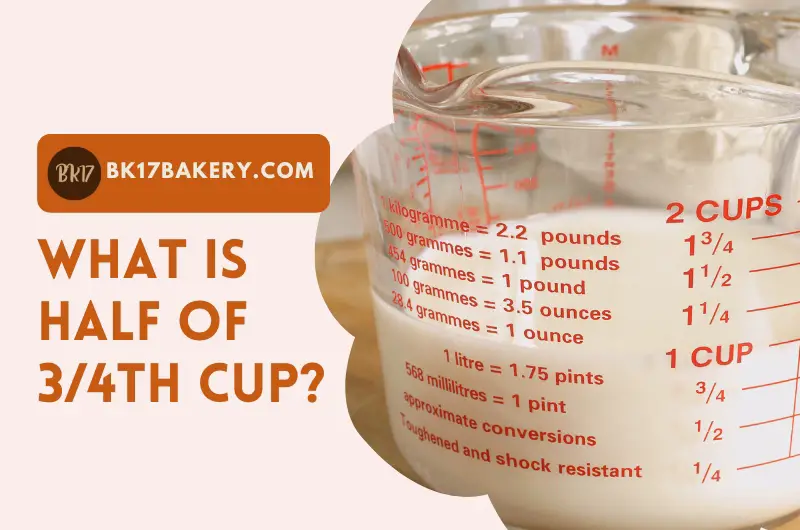
Understanding the Fraction: A Breakdown of 3/4 Cup
The fraction 3/4 cup serves as a fundamental measurement in countless recipes, bridging precision and practicality in cooking and baking. Its mathematical simplicity masks a depth of application, from scaling ingredients to achieving consistent texture and flavor. To master this measurement, one must first grasp its numerical and visual representation, its conversion across systems, and its adaptability in real-world kitchen scenarios. This breakdown dissects the fraction’s core components—its decimal and percentage equivalents, its physical manifestation in tools, and its division into smaller units—while contextualizing its role in culinary traditions and troubleshooting common challenges.
Mathematical Foundation of 3/4 Cup

The fraction 3/4 cup originates from dividing a whole cup into four equal parts and selecting three of them. In decimal form, 3/4 equals 0.75, while its percentage equivalent is 75%. This conversion is critical for recipes requiring precise scaling, such as those in baking where chemical reactions depend on exact ingredient ratios. For example, a recipe calling for 3/4 cup of flour in a 12-cup batter means the flour constitutes 6.25% of the total volume, assuming uniform distribution. Understanding these relationships allows cooks to adjust recipes dynamically, whether doubling a batch or converting between metric and imperial systems.
Visual Representation and Volume Comparison
A 3/4 cup measurement can be visualized through a comparative table that maps fractional cups to milliliters (ml) and fluid ounces (fl oz), the standard units in metric and U.S. systems, respectively. Below is a structured breakdown using a standard U.S. cup, where 1 cup = 236.588 ml or 8 fl oz:
| Fraction of Cup | Milliliters (ml) | Fluid Ounces (fl oz) | Visual Description |
|---|---|---|---|
| 1/4 cup | 59.15 ml | 2 fl oz | A standard measuring cup filled to the first horizontal line. |
| 1/2 cup | 118.29 ml | 4 fl oz | Filled to the second line, equivalent to two 1/4 cups. |
| 3/4 cup | 177.44 ml | 6 fl oz | Filled to the third line, surpassing the halfway mark but not reaching the rim. |
| 1 cup | 236.59 ml | 8 fl oz | Completely filled to the top rim. |
| 1.5 cups | 355 ml | 12 fl oz | Equivalent to 1 cup plus 3/4 cup, or six 1/4 cups. |
This table underscores the incremental nature of fractional measurements, where each step builds upon the previous. For instance, 3/4 cup is precisely 1.5 times the volume of 1/2 cup, a relationship that simplifies mental calculations during recipe adjustments.
Representation in Kitchen Measurement Tools
Accurate measurement of 3/4 cup relies on the proper use of kitchen tools, each with distinct characteristics. Standard U.S. measuring cups are nested, with markings for 1/4, 1/3, 1/2, and 3/4 cups, often accompanied by a separate 1-cup measure. These cups are typically made of glass or stainless steel, with laser-etched lines for precision. For liquid ingredients, the measurement should be taken at eye level, ensuring the meniscus (the curved surface of the liquid) aligns with the 3/4 cup line.
Digital kitchen scales offer an alternative, particularly for dry ingredients like flour or sugar, where 3/4 cup translates to approximately 150 grams (varies by ingredient density). Spoon-based measurements, though less common, can approximate 3/4 cup using 1 tablespoon = 1/16 cup, meaning 3/4 cup = 12 tablespoons. However, this method is prone to error due to variations in spoon sizes and ingredient packing.
Dividing 3/4 Cup into Smaller Fractions
Breaking down 3/4 cup into smaller units—such as 1/8 or 1/16 cups—enhances precision in recipes requiring incremental adjustments. To visualize this, imagine a standard 1-cup measure divided into 8 equal parts (each representing 1/8 cup). 3/4 cup would then occupy 6 of these parts (since 3/4 ÷ 1/8 = 6). For even finer divisions, consider 1/16 cup increments: 3/4 cup = 12 parts.
Step-by-Step Procedure for Division: 1. Fill a 1/2 cup measure to the brim and pour half (1/4 cup) into a separate container. 2. Retain the remaining 1/4 cup and add 1/4 cup from another measure to reach 1/2 cup. 3. Pour 1/4 cup from this 1/2 cup into the original container, resulting in 3/4 cup. 4. To further divide, use a 1/8 cup measure (or a teaspoon, where 3 teaspoons = 1/8 cup) to extract smaller quantities.
This method ensures accuracy, especially in recipes like soufflés or mousses, where slight variations can affect texture.
Real-World Volume Comparisons
Relating 3/4 cup to everyday objects provides a tangible sense of its volume. Below are comparisons to common household items, assuming standard sizes:
- Ice Cubes: A standard ice cube tray (1.5-inch cubes) yields approximately 16 cubes per 1 cup. Thus, 3/4 cup ≈ 12 ice cubes. - Golf Balls: A U.S. golf ball has a diameter of 1.68 inches, with a volume of roughly 2.75 cubic inches. 3/4 cup (≈ 14.4 cubic inches) would hold about 5.2 golf balls. - Soda Cans: A 12 fl oz soda can is equivalent to 1.5 cups. Therefore, 3/4 cup ≈ half of a 12 fl oz can (or 6 fl oz). - Eggs: A large U.S. egg averages 50 ml. 3/4 cup (≈ 177 ml) is roughly equivalent to 3.5 eggs’ volume, though this is less practical for measurement.
These analogies serve as quick references when precise tools are unavailable, though they should not replace standardized measurements for critical recipes.
Historical Context of Fractional Measurements in Cooking
Fractional measurements like 3/4 cup trace their origins to 18th-century England, where standardized recipes emerged alongside the rise of domestic cookbooks. The U.S. adopted these imperial measurements post-Revolution, embedding them into culinary culture. In contrast, the metric system, introduced in France during the same era, gained global traction but remains secondary in American cooking. This divergence explains why 3/4 cup is ubiquitous in U.S. recipes, while metric conversions (180 ml) are more common in Europe and Asia.
Traditional recipes often rely on fractions for their flexibility and simplicity. For example, a pie crust might require 3/4 cup of cold butter, a measurement easily halved or doubled without complex calculations. The persistence of fractional measurements also reflects cultural inertia; many home cooks prefer the familiarity of cups and spoons over metric conversions, despite the precision offered by grams or milliliters.
Common Misconceptions and Corrections
A pervasive misconception in cooking is interpreting 3/4 cup as three separate 1/4 cup measurements. While mathematically equivalent (3 × 1/4 = 3/4), this approach introduces practical errors: - Ingredient Packing: Scooping flour or
Mastering Precision: Three Mathematical Methods to Calculate Half of 3/4 Cup
Understanding how to accurately halve 3/4 cup ensures consistency in cooking and baking, where even minor measurement discrepancies can alter texture, flavor, or structure. Whether adjusting recipes for dietary needs, scaling down portions, or substituting ingredients, precise calculations are essential. Below are three distinct mathematical approaches—fraction multiplication, decimal conversion, and visual division—that break down the process into clear, actionable steps. Each method offers unique advantages, from simplicity to practical application, catering to different comfort levels with arithmetic and measurement tools.
Fraction Multiplication: Halving 3/4 Cup Using Basic Arithmetic
Fraction multiplication is the most straightforward method for those comfortable with arithmetic operations. To find half of 3/4 cup, multiply the fraction by 1/2, which represents the halving factor. The process involves multiplying the numerators (top numbers) and denominators (bottom numbers) separately, then simplifying the result if possible.
Step-by-Step Procedure: 1. Set Up the Multiplication: Write the fraction 3/4 and multiply it by 1/2: 3/4 × 1/2 2. Multiply Numerators and Denominators: Multiply the numerators: 3 × 1 = 3. Multiply the denominators: 4 × 2 = 8. The result is 3/8.
3. Simplify the Fraction (if needed): In this case, 3/8 is already in its simplest form, as 3 and 8 have no common divisors other than 1.
Key Insight: This method is ideal for those who prefer working with fractions and have a basic understanding of multiplication rules. It ensures accuracy without relying on conversion tools, making it reliable for scenarios where measuring instruments are unavailable.
Decimal Conversion: Converting and Halving 3/4 Cup Using Decimals
Decimal conversion simplifies the halving process for individuals more comfortable with decimal numbers. Converting 3/4 cup to its decimal equivalent (0.75) allows for straightforward multiplication by 0.5 (half). This approach is particularly useful when working with digital scales or recipes that use metric measurements.
Step-by-Step Procedure: 1. Convert 3/4 Cup to Decimal: Divide the numerator by the denominator: 3 ÷ 4 = 0.75. So, 3/4 cup = 0.75 cups.
2. Multiply by 0.5 to Find Half: Multiply 0.75 × 0.5 = 0.375. The result is 0.375 cups.
3. Convert Back to Fraction (Optional): To express 0.375 as a fraction, recognize that it equals 3/8 cup (since 0.375 = 375/1000, which simplifies to 3/8 when divided by 125).
Advantages of Decimal Method: This technique is useful for quick mental calculations and aligns with metric measurements, which are standard in many international recipes. It also bridges the gap between fractions and decimals, making it easier to cross-reference with other measurement systems.
Visual Division: Splitting a 3/4 Cup Illustration into Two Equal Parts
Visual division leverages spatial understanding to halve 3/4 cup without arithmetic. Imagine a standard measuring cup divided into fourths, where 3/4 cup fills three of the four sections. To halve it visually, divide the filled sections into two equal portions. This method is intuitive for visual learners or those without access to measuring tools.
Step-by-Step Procedure: 1. Visualize the Measuring Cup: A typical liquid measuring cup has markings for 1/4 cup, 1/2 cup, 3/4 cup, and 1 cup. Fill it to the 3/4 cup line.
2. Divide the Filled Volume: To split 3/4 cup into two equal parts, mentally or physically divide the filled volume into halves. Since 3/4 cup is 1/4 cup short of a full cup, halving it involves: - Recognizing that 3/4 cup = 6/8 cup (doubling the denominator to make division easier). - Dividing 6/8 cup by 2 yields 3/8 cup per half.
3. Practical Application: Pour the liquid into two separate containers, ensuring each receives an equal share of the 3/4 cup volume. For example, if making a sauce, divide the 3/4 cup of liquid into two 3/8 cup portions for two smaller batches.
Why Visual Division Matters: This method is invaluable in scenarios where tools are limited, such as camping or quick kitchen adjustments. It also reinforces the relationship between fractions and proportional reasoning, which is critical for scaling recipes.
Measuring Half of 3/4 Cup Using Only a 1/4 Cup Measure
When a 1/4 cup measure is the only available tool, halving 3/4 cup requires strategic use of the smaller measurement. This method relies on understanding that 3/4 cup = 3 × 1/4 cup, allowing for incremental measurement. However, precision depends on careful pouring and accounting for potential errors.
Detailed Procedure: 1. Understand the Relationship: 3/4 cup = 3 × 1/4 cup. To halve 3/4 cup, you need 1.5 × 1/4 cup, which is 3/8 cup.
2. Measure Incrementally: - Use the 1/4 cup measure to scoop out 1/4 cup twice. This gives you 1/2 cup, which is 4/8 cup or 2/8 cup more than needed. - To reach 3/8 cup, pour 1/4 cup once (2/8 cup) and then add half of another 1/4 cup measure. This requires estimating or using a smaller tool (e.g., a tablespoon) to add 1/8 cup (since 1/4 cup = 2 tablespoons, half of 1/4 cup = 1 tablespoon).
3. Potential Errors and Solutions: - Overpouring: If the 1/4 cup measure is not level, the measurement may be inaccurate. Always scrape off excess with a straight edge (e.g., a knife) to ensure precision. - Underestimating Halves: Pouring half of 1/4 cup freehand can lead to inconsistency. Use a smaller measure (e.g., 1 tablespoon) for better accuracy. - Sticky Residue: Liquid may cling to the sides of the measure, reducing the actual volume. Rinsing the measure with warm water before use minimizes residue.
Pro Tip: For repeated use, mark the 1/4 cup measure at the 1/8 cup line (which is 2 tablespoons) using a permanent marker. This visual guide simplifies future halving tasks.
Comparative Analysis: Half of 3/4 Cup vs. Other Common Baking Fractions
Understanding how half of 3/4 cup compares to other fractions is critical for recipe adjustments. Below is a responsive table outlining the halved values of common baking fractions, including their decimal and milliliter equivalents for cross-referencing.
| Original Fraction | Half of Fraction | Decimal Equivalent | Milliliters (Approx.) |
|---|---|---|---|
| 1/4 cup | 1/8 cup | 0.125 | 30 mL |
| 1/2 cup | 1/4 cup | 0.25 | 60 mL |
| 3/4 cup | 3/8 cup | 0.375 | 90 mL |
| 1 cup | 1/2 cup | 0.5 | 120 mL |
| 1 1/2 cups | 3/4 cup | 0.75 | 180 mL |
| 2 cups | 1 cup | 1.0 | 240 mL |
Insights from the Table: - Halving 3/4 cup yields 3/8 cup, which is equivalent to 0.375 cups or 90 mL. This value falls between 1/4 cup (60 mL) and 1/2 cup (120 mL), making it a moderate measurement in baking contexts. - For recipes requiring 3/8 cup, using a 1/4 cup measure twice and adjusting with a tablespoon (as previously described) is
Practical Applications: Recipes and Cooking Scenarios Where Halving 3/4 Cup Transforms Culinary Outcomes
Understanding how halving 3/4 cup impacts recipes is essential for home cooks, bakers, and chefs who frequently adjust ingredient ratios. Whether scaling down for smaller servings, testing new recipes, or working with limited ingredients, precision in measurement directly influences texture, flavor, and structural integrity. This section explores five widely used recipes where 3/4 cup plays a critical role, demonstrating how halving this measurement alters the final product. It also addresses ingredient-specific adjustments—such as the difference between liquids and dry goods—and provides actionable strategies for scaling recipes accurately, including cross-cultural adaptations and quick-fix solutions.
Five Recipes Where 3/4 Cup Is a Key Ingredient and How Halving It Affects Results
Recipes often rely on 3/4 cup of foundational ingredients like flour, milk, or oil to achieve the desired consistency and flavor. Halving this measurement can drastically change the outcome, from denser baked goods to thinner sauces. Below are five popular recipes where 3/4 cup is pivotal, along with the expected adjustments when halving:
- Fluffy Buttermilk Pancakes The original recipe requires 3/4 cup buttermilk for a batch of six pancakes. Halving this to 6 tablespoons (3/8 cup) reduces the batter’s moisture content, resulting in pancakes that are thicker, potentially drier, and less tender. To compensate, adding 1 tablespoon of milk or water and increasing the leavening agent (baking powder) by 1/8 teaspoon helps restore lift and moisture balance.
- Classic Blueberry Muffins A standard muffin recipe calls for 3/4 cup all-purpose flour as part of a dry mix. Reducing this to 6 tablespoons (3/8 cup) alters the crumb structure, yielding muffins that are denser and more compact. To maintain aeration, replace the missing 1/4 cup flour with 2 tablespoons cornstarch or 1 tablespoon cake flour, which enhances tenderness without overpowering the flavor.
- Creamy Tomato Basil Soup This soup typically includes 3/4 cup heavy cream for richness. Halving it to 6 tablespoons (3/8 cup) creates a lighter, less velvety texture. To preserve creaminess, substitute with 1/4 cup Greek yogurt or coconut milk, which adds protein or a subtle sweetness while maintaining a smooth consistency.
- Homemade Mayonnaise Traditional mayonnaise recipes often use 3/4 cup neutral oil (like vegetable or canola) per batch. Reducing this to 6 tablespoons (3/8 cup) produces a thinner, less stable emulsion. To achieve the same thickness, either:
- Gradually add 1 tablespoon of oil at a time while whisking vigorously, or
- Replace the missing 1/4 cup oil with 2 tablespoons of melted butter, which contributes fat while adding a richer flavor.
- Chocolate Chip Cookies The original dough recipe includes 3/4 cup unsalted butter for a batch of 24 cookies. Halving this to 6 tablespoons (3/8 cup) yields cookies that spread less and have a firmer, cake-like texture. To restore chewiness and spread, replace the missing 1/4 cup butter with 2 tablespoons of vegetable oil, which promotes browning and a softer bite.
Side-by-Side Comparison: Full Recipe vs. Halved Recipe Adjustments
Scaling a recipe requires more than just halving a single ingredient—it involves recalibrating ratios, baking times, and techniques. Below is a responsive table comparing a full batch of Classic Vanilla Cake (requiring 3/4 cup all-purpose flour and 3/4 cup whole milk) with a halved version, including critical adjustments for oven temperature, leavening agents, and mixing methods.
| Parameter | Full Recipe (12 servings) | Halved Recipe (6 servings) | Adjustment Notes |
|---|---|---|---|
| All-Purpose Flour | 3/4 cup (90g) | 6 tablespoons (3/8 cup, 45g) | Sift flour to maintain aeration; replace missing 1/4 cup with 2 tbsp cornstarch for tenderness. |
| Whole Milk | 3/4 cup (180ml) | 6 tablespoons (3/8 cup, 90ml) | Reduce liquid slightly to prevent a gummy texture; add 1 tbsp yogurt for moisture retention. |
| Baking Powder | 2 teaspoons | 1 teaspoon + 1/2 teaspoon | Increase by 1/8 tsp to compensate for reduced leavening from less flour. |
| Baking Time | 30–35 minutes at 350°F (175°C) | 20–25 minutes at 350°F (175°C) | Smaller volume cooks faster; use a toothpick test to check doneness. |
| Oven Temperature | 350°F (175°C) | 350°F (175°C) or 325°F (165°C) for denser cakes | Lower temp prevents over-browning in smaller batches. |
| Mixing Method | Cream butter and sugar, then alternate with dry and wet ingredients | Same method, but mix for 10–15 seconds less to avoid overdevelopment | Overmixing in smaller batches leads to tougher crumb. |
| Expected Outcome | Moist, tender layers with even rise | Denser but still tender; may require extra frosting for richness | Halved recipes often benefit from a thicker glaze or filling to enhance flavor. |
Adjusting Ingredient Ratios When Halving 3/4 Cup: Liquid vs. Dry Ingredients
Halving 3/4 cup requires distinct approaches for liquid and dry ingredients, as volume, packing density, and chemical reactions vary significantly. Below are key considerations:
- Dry Ingredients: Packing and Volume Variations Ingredients like flour, sugar, and brown sugar compress differently, affecting volume. For example:
- All-Purpose Flour: Lightly spoon into the measuring cup, then level off. Halving 3/4 cup (90g) to 6 tablespoons (3/8 cup, ~45g) requires precise leveling to avoid under- or over-measuring.
- Brown Sugar: Pack firmly when measuring. 3/4 cup packed brown sugar (150g) halved to 6 tablespoons (3/8 cup, ~75g) must be packed to the same density to maintain moisture in recipes like cookies.
- Powdered Sugar: Sift before measuring to prevent clumping. Halving 3/4 cup (90g) to 6 tablespoons (3/8 cup, ~45g) should use a fine-mesh sieve for even distribution.
- Liquid Ingredients: Volume and Substitution Nuances Liquids are measured by volume, but substitutions can alter texture:
- Milk or Water:
- For a paper cup: Fill it to the brim with water and pour into a measuring cup to determine its total volume (e.g., 250 mL). Divide the cup into quarters by marking lines with a permanent marker. To measure 3/4 cup (180 mL), fill the cup to the 72% mark (180/250 × 100).
- For a tablespoon: Weigh 15 mL of water on a digital scale (approximately 15 grams). Use this as a baseline to measure 3/4 cup by counting 12 tablespoons (180 mL). For dry ingredients, level each scoop to avoid compaction errors.
- For a shot glass (45 mL): Fill it four times to reach 3/4 cup (180 mL). Halving 3/4 cup requires filling the shot glass twice (90 mL) or using a smaller container marked at 45 mL. Step 3: Account for Ingredient Density Calibration assumes water’s density. For dry ingredients like flour, which compacts differently, use the "spoon and level" technique: scoop the ingredient into the improvised tool and level it off with a knife. Repeat until the target volume is reached. For dense ingredients like brown sugar, press gently to fill the container without packing. Verification Tip: Recheck measurements by transferring the calibrated amount into a standard measuring cup. Adjust markings if discrepancies exceed 5% of the target volume.
- Issue: Residue from sticky ingredients (e.g., honey, peanut butter) alters volume markings.
- Solution: Rinse with warm water and dry thoroughly. For stubborn residues, soak in warm soapy water, then scrub with a bottle brush. Recalibrate by filling with water to ensure markings align with standard volumes. 2. Chipped or Worn Markings
- Issue: Physical damage to measurement lines makes it difficult to gauge precise volumes.
- Solution: Use a permanent marker to retrace faded lines or create a new reference point by filling the cup with water and marking the meniscus (curved surface) at 3/4 cup (180 mL). For digital scales, weigh the ingredient directly to bypass visual cues. 3. Misaligned or Uneven Containers
- Issue: Improperly shaped containers (e.g., a lopsided paper cup) cause spillage or inaccurate fill levels.
- Solution: Place the container on a level surface before filling. For liquids, pour slowly to avoid overflow. For dry ingredients, use a straightedge tool (e.g., a ruler) to level the top. 4. Angle of Pouring
- Issue: Pouring liquids at an angle creates air bubbles or uneven meniscus levels.
- Solution: Hold the container upright and pour gradually. For viscous liquids (e.g., syrup), use a spoon to guide the flow and minimize air pockets. Compensation Techniques: If a tool is 5% under or over the target volume, adjust by adding or subtracting 1.5 tablespoons (22 mL) for 3/4 cup. For critical recipes (e.g., baking), switch to a calibrated alternative.
- Method: Weigh ingredients by mass rather than volume. For 3/4 cup (180 mL) of water, the equivalent weight is 180 grams. Create a cheat sheet for common ingredients:
- All-purpose flour: 3/4 cup ≈ 90 grams (spooned and leveled).
- Granulated sugar: 3/4 cup ≈ 150 grams (packed lightly).
- Butter (room temperature): 3/4 cup ≈ 170 grams.
- Advantage: Eliminates volume inconsistencies caused by ingredient packing or temperature. 2. Volume Displacement Method
- Method: Use a graduated cylinder or beaker filled with water to displace volume. For 3/4 cup (180 mL): 1. Fill the cylinder to a known level (e.g., 300 mL). 2. Submerge the ingredient (e.g., a scoop of flour) until it displaces 180 mL. 3. Record the new water level to determine the exact volume.
- Application: Ideal for liquid ingredients or when measuring irregularly shaped items (e.g., chopped nuts). 3. Hydrometer and Density Adjustments
- Method: For ingredients with varying densities (e.g., honey vs. water), use a hydrometer to measure specific gravity. Adjust volumes based on pre-calculated ratios:
- Honey (1.4 kg/L): 3/4 cup (180 mL) ≈ 252 grams (vs. 180 grams for water).
- Oil (0.9 kg/L): 3/4 cup ≈ 162 grams.
- Tool: A kitchen refractometer or pre-made density tables for common ingredients.
- Visual Aid: Imagine the measuring cup as a level playing field. For dry ingredients, use a straight-edged utensil (e.g., a butter knife) to scrape excess flush with the rim. For liquids, place the cup on a flat surface and eye-level with the measurement line to avoid parallax errors.
- User Anecdote: A baker in Portland shared how her chocolate chip cookies turned brittle after using a heaped 3/4 cup of flour instead of the level measurement. The recipe called for a precise ratio of flour to butter, and the excess flour absorbed too much moisture, resulting in a dry, crumbly texture. Switching to a spoon-and-level method resolved the issue.
- Experiment: Measure 3/4 cup of rice using a standard cup, then weigh it against a gram scale. Repeat with a heaped cup and note the difference—typically 20–30 grams more for a heaped measurement. 2. Using the Wrong Tool for Dry vs. Liquid Ingredients Measuring cups designed for liquids (often with spouts) and dry ingredients (rimmed) serve distinct purposes. Using a liquid cup for dry ingredients like powdered sugar can cause spillage and compaction, while using a dry cup for honey or oil may lead to inaccurate volume due to surface tension. Additionally, nesting measuring cups (e.g., 1/4 cup inside a 1/2 cup) can trap residual ingredients, skewing measurements. Corrective Action Plan:
- Visual Aid: Dry ingredients should be measured in rimmed cups with a straight edge for leveling. Liquids require clear, marked cups placed on a stable surface. For sticky ingredients (e.g., molasses), use a lightly oiled spoon to transfer contents.
- User Anecdote: A home cook in London attempted to measure 3/4 cup of condensed milk using a dry measuring cup, only to find the milk clinging to the sides. The resulting caramel sauce was too thin due to the missing volume. Switching to a liquid measuring cup and tapping the cup gently to release air bubbles solved the problem.
- Experiment: Fill a liquid cup to the 3/4 mark with water, then pour it into a dry measuring cup. Observe how surface tension causes the water level to rise above the rim, demonstrating the need for separate tools. 3. Misinterpreting "Packed" vs. "Loosely Filled" Measurements Ingredients like brown sugar or shredded coconut require packing to achieve accurate volume, yet many cooks overlook this distinction. Brown sugar, for instance, can vary in moisture content, and packing it too tightly or too loosely alters its density. A loosely filled 3/4 cup of brown sugar may yield only 60% of the packed volume, leading to imbalanced sweetness or texture in recipes like spice rubs or quick breads. Corrective Action Plan:
- Visual Aid: Pack brown sugar by pressing firmly with a spoon until it holds its shape when the cup is inverted. The sugar should not spill out but should also not feel compressed like a brick. For shredded coconut, press it into the cup until it resists deformation.
- User Anecdote: A chef in New York City recounted a failed batch of gingerbread cookies where the brown sugar was measured loosely. The cookies lacked moisture and spread unevenly. After consulting a density chart, she adjusted by packing the sugar and achieved the chewy, moist texture expected.
- Experiment: Weigh a loosely filled 3/4 cup of brown sugar, then pack it and weigh again. The difference can exceed 50 grams, highlighting the importance of technique. 4. Assuming 1/2 of 3/4 Cup Equals 1/2 Cup A mathematically tempting but fundamentally incorrect assumption, this error arises from misapplying fraction logic. Half of 3/4 cup is 3/8 cup, not 1/2 cup. This mistake is particularly common in recipes requiring halving or doubling measurements, such as sauces or marinades, where even small discrepancies affect flavor and consistency. Corrective Action Plan:
- Formula:
- 3/8 cup ≈ 6 tablespoons (since 1/4 cup = 4 tbsp, 3/8 = 3/4 × 4 tbsp = 3 tbsp).
- Visual Aid: Use a measuring cup with 1/8 cup markings or combine a 1/4 cup and 2 tablespoons for precision. Alternatively, fill a 1/4 cup halfway to approximate 3/8 cup.
- User Anecdote: A home cook in Australia attempted to halve a 3/4 cup of tomato paste for a stew by using 1/2 cup. The sauce turned too watery and lacked depth. After recalculating, she used 3/8 cup (6 tbsp), restoring the intended richness.
- Experiment: Pour 3/4 cup of water into a measuring cup, then divide it into two equal portions. Compare the result to 1/2 cup—most will find the actual half is significantly less. 5. Ignoring Ingredient Temperature or Density Changes Temperature and density fluctuations can alter ingredient volume unpredictably. For example:
- Butter: Softened butter expands when melted, increasing volume by up to 15%.
- Flour: Stored in a cold environment, flour can become compacted, reducing its volume when scooped.
- Honey: Thickens in cool temperatures, requiring gentle heating to achieve accurate measurements. Failing to account for these factors leads to overly greasy pastries, dense muffins, or runny glazes. Corrective Action Plan:
- Visual Aid:
- Butter: Use the "pack-and-scoop" method—pack softened butter into the measuring cup without pressing air bubbles. For melted butter, cool slightly before measuring to minimize expansion.
- Flour: Store flour in an airtight container and scoop it directly from the bag to avoid compaction. Use a flour sifter to aerate pre-measured amounts.
- Honey: Warm the jar in lukewarm water for 2–3 minutes, then stir and measure. Avoid overheating, which can alter flavor.
- User Anecdote: A baker in Canada discovered her scones were greasy after using melted butter measured at room temperature. Switching to packed softened butter at 65°F (18°C) resolved the issue, yielding flaky layers.
- Experiment: Measure 3/4 cup of cold honey and compare it to the same volume after heating. The cold honey may require up to 1/4 cup more to fill the same space, demonstrating density’s role.
- Volume (3/4 cup flour): May range from 90–110 grams depending on how tightly it’s packed.
- Weight (1
Tools and Techniques for Accurate Measurement of 3/4 Cup and Its Half
Precision in cooking and baking hinges on the accuracy of ingredient measurements, where even minor deviations can alter texture, flavor, or structural integrity. Whether working with standard kitchen tools or improvising with household items, understanding the capabilities and limitations of each method ensures consistency. This section explores five common kitchen tools, their precision levels, and practical techniques—including calibration, troubleshooting, and advanced methods—to measure 3/4 cup and its half with reliability. It also addresses how environmental factors like temperature and ingredient density influence volume, alongside actionable solutions for compensation.Comparison of Five Common Kitchen Tools for Measuring 3/4 Cup and Its Half
The choice of tool significantly impacts measurement accuracy, especially when halving fractions like 3/4 cup. Below is a comparative analysis of measuring cups, spoons, digital scales, gradated cylinders, and improvised tools, focusing on precision, ease of use, and suitability for dry and liquid ingredients. Measuring cups and spoons are the most accessible tools but vary in precision. Standard U.S. measuring cups (typically nested sets) are molded from stainless steel or plastic and marked with liquid and dry measurement lines. For 3/4 cup, liquid measurements are more precise due to clear fill lines, while dry ingredients like flour require the "spoon and level" method to avoid overpacking. Measuring spoons (e.g., 1/4, 1/3, and 1/2 cup sizes) offer convenience for smaller volumes but lack the granularity needed for halving 3/4 cup without additional calculations. Digital scales provide the highest precision, measuring ingredients by weight (e.g., grams or ounces) rather than volume. For 3/4 cup of water, this translates to approximately 180 grams (varies by ingredient density). Scales eliminate volume discrepancies caused by ingredient packing or temperature but require conversion formulas or a pre-made reference chart. Gradated cylinders, often found in laboratory or professional settings, offer milliliter markings for liquids but are impractical for dry ingredients due to spillage risks. Improvised tools, such as a standard tablespoon (15 mL), can approximate 3/4 cup (180 mL) by multiplying 15 mL by 12 (since 1 cup = 16 tablespoons). However, this method introduces cumulative error, especially for dry ingredients where scooping inconsistencies occur. The accuracy of improvised tools hinges on calibration, as discussed in the next section.Calibrating Improvised Tools for Measuring 3/4 Cup and Its Half
When standard tools are unavailable, household items like paper cups, shot glasses, or plastic containers can serve as makeshift measuring aids—provided they are calibrated. Below are step-by-step methods to ensure accuracy when using non-traditional tools. Step 1: Select a Reference Standard Begin with a known volume, such as a standard 8-ounce (240 mL) measuring cup or a digital scale. For liquids, use water, which has a consistent density. For dry ingredients, use granulated sugar or rice, which pack uniformly when leveled. Step 2: Mark Incremental LevelsTroubleshooting Common Measurement Errors
Dirty, chipped, or misaligned tools can introduce errors that compromise recipes. Below are solutions to mitigate inaccuracies when measuring 3/4 cup and its half. 1. Dirty or Sticky Measuring CupsAdvanced Techniques for Professional Precision
Professional kitchens employ specialized methods to achieve millimeter-level accuracy when measuring 3/4 cup and its half. Below are three techniques used in commercial and high-end home baking. 1. Baking Scale with Conversion ChartsHousehold Items for Approximating 3/4 Cup and Its Half
In a pinch, everyday objects can serve as rough volume references. BelowCommon Mistakes and How to Avoid Them in Measuring 3/4 Cup and Its Half
Precision in measuring ingredients like 3/4 cup is the cornerstone of successful cooking and baking. Even minor deviations can drastically alter the outcome, leading to undercooked dishes, overly dense baked goods, or recipes that fail entirely. Despite its apparent simplicity, measuring 3/4 cup—or its half—is a task prone to errors, often due to misconceptions, improper techniques, or environmental factors. Understanding these pitfalls and implementing corrective strategies ensures consistency and reliability in culinary results. Below are five frequent mistakes, their consequences, and actionable solutions backed by practical insights and psychological considerations.Five Frequent Errors in Measuring 3/4 Cup and Corrective Strategies
Accurate measurement begins with recognizing common missteps that compromise ingredient integrity. These errors often stem from assumptions, tool mismanagement, or overlooking ingredient properties. Addressing them requires a combination of technique refinement, tool awareness, and environmental adjustments. 1. Overfilling or Underfilling Measuring Cups Many home cooks mistakenly heap ingredients above the rim of a measuring cup or fail to level them off, leading to inconsistent volumes. For dry ingredients like flour or sugar, this can result in 10–20% variation in actual weight, significantly impacting recipes like cakes or cookies where precision is critical. Liquid ingredients, when overfilled, spill over, while underfilling leaves gaps that affect texture and moisture balance. Corrective Action Plan:Half of 3/4 cup = (3/4) ÷ 2 = 3/8 cup To convert 3/8 cup to a more usable measurement:
Psychology of Measurement Errors: Why Precision Fails and How to Retrain
Measurement errors often stem from cognitive biases and habitual shortcuts rather than a lack of knowledge. Understanding these psychological traps can help cooks develop deliberate, precise techniques. 1. The Overconfidence Bias Many assume they measure accurately without verification, leading to systematic overestimation (e.g., heaping cups) orAdvanced Uses: The Science and Mathematics Behind 3/4 Cup
Fractions like 3/4 cup are more than mere culinary measurements—they represent fundamental mathematical principles that bridge everyday cooking with advanced scientific applications. Understanding the underlying geometry, unit conversions, and precision in fractions enables accurate scaling in chemistry, nutrition, and engineering. From adjusting recipe ratios for dietary needs to ensuring precise chemical reactions, the interplay between fractions, volume, and weight reveals how a simple measurement can transform both practical and theoretical outcomes. This exploration delves into the mathematical rigor of 3/4 cup, its role in scientific conversions, and its geometric implications in measurement tools.Mathematical Foundations of Fractions in Cooking
Fractions like 3/4 cup rely on the division of a whole into equal parts, a concept rooted in elementary arithmetic. When a recipe specifies 3/4 cup, it implies that the total volume (1 cup) is divided into four equal sections, with three of those sections being used. This principle extends beyond cooking into real-world analogies, such as splitting a pizza into quarters. If a pizza is divided into four equal slices, 3/4 of the pizza would represent three slices, demonstrating how fractions quantify portions of a discrete whole. Multiplication and division further refine these measurements. For instance, halving 3/4 cup involves dividing the fraction by 2, resulting in 3/8 cup. This operation adheres to the rule of multiplying the numerator by the reciprocal of the denominator: 3/4 ÷ 2 = 3/4 × 1/2 = 3/8. Such calculations are critical in recipe scaling, where doubling or halving ingredients requires precise arithmetic to maintain consistency in texture, flavor, and chemical reactions.Unit Conversions: Bridging Cooking and Scientific Measurements
The 3/4 cup measurement transcends the kitchen by integrating with global systems of measurement, including metric and scientific units. In the metric system, 1 cup is equivalent to approximately 236.588 milliliters (mL), meaning 3/4 cup converts to: 3/4 × 236.588 mL ≈ 177.441 mL. For scientific applications, this volume can be further broken down into cubic centimeters (cm³), where 1 mL = 1 cm³, making 3/4 cup ≈ 177.441 cm³. Below is a conversion table for 3/4 cup across common systems, useful in both culinary and laboratory settings:| Unit | 3/4 Cup Equivalent | Practical Application |
|---|---|---|
| Milliliters (mL) | 177.441 mL | Used in metric-based recipes or chemical solutions. |
| Cubic Centimeters (cm³) | 177.441 cm³ | Standard in scientific measurements for volume. |
| Fluid Ounces (fl oz) | 6 fl oz | Common in U.S. liquid measurements. |
| Grams (g) for Water | 177.441 g (since 1 mL water ≈ 1 g) | Critical in nutritional labeling and density calculations. |
| Teaspoons (tsp) | 48 tsp | Useful for precise dosing in pharmaceuticals or baking. |
Fractions in Chemistry: Precision in Recipe Scaling and Mole Ratios
Chemistry frequently employs fractions to maintain precise mole ratios in reactions, and cooking shares this necessity when scaling ingredients for experiments or dietary modifications. For instance, a chemical solution requiring 3/4 cup of a solvent may need to be halved to 3/8 cup while preserving the molarity. This principle extends to culinary chemistry, where halving a recipe’s 3/4 cup of vinegar for a marinade requires recalculating acidity levels to ensure food safety and flavor balance. In nutritional chemistry, fractions determine macronutrient distribution. If a recipe’s 3/4 cup of olive oil provides 140 calories and 16 grams of fat, halving it to 3/8 cup would yield: 70 calories and 8 grams of fat. This calculation is critical for diet planning, where precise energy and nutrient intake must be maintained.Scientific Notation and Engineering Applications of 3/4 Cup
Converting 3/4 cup into scientific notation (for very large or small measurements) or engineering notation (for practical applications) involves expressing the value as a power of 10. Given that 3/4 cup ≈ 177.441 mL, its scientific notation is: 1.77441 × 10² mL. For engineering notation, which uses multiples of 1000, the same value becomes: 177.441 × 10⁰ mL (or 0.177441 × 10³ mL). These notations are valuable in food engineering, where measurements must be standardized for mass production. For example, a beverage manufacturer might use engineering notation to scale 3/4 cup servings into 177.441 × 10⁰ mL batches for packaging efficiency. Similarly, in culinary research, scientific notation helps compare micro and macro measurements, such as analyzing the viscosity of sauces where 3/4 cup ingredients are tested in controlled experiments.Nutritional Calculations: Halving Ingredients for Dietary Precision
Nutritional accuracy depends on precise ingredient measurements, particularly when halving recipes. For example, a 3/4 cup serving of quinoa contains approximately 222 calories and 39 grams of carbohydrates. Halving this to 3/8 cup reduces the nutritional profile to: 111 calories and 19.5 grams of carbohydrates. Such calculations are essential for meal planning apps, clinical diets, or athletic training programs where macronutrient ratios must be strictly controlled. To perform these calculations: 1. Identify the original nutritional value per 3/4 cup. 2. Divide the value by 2 to halve the serving. 3. Adjust for density variations (e.g., packed vs. scooped flour), as weight measurements are more reliable for nutritional accuracy.Geometry of Measuring Cups: Volume Accuracy in Cylindrical vs. Conical Shapes
The shape of a measuring cup directly impacts volume accuracy. Cylindrical measuring cups, with their straight sides and flat bottoms, provide consistent measurements because their volume increases linearly with height. In contrast, conical or tapered cups may introduce errors if not filled to the brim, as the slope of the sides alters the volume-to-height ratio. For 3/4 cup, a cylindrical cup ensures that the marked line corresponds to 177.441 mL when filled to the rim. However, if the cup has a slight taper, the actual volume may deviate by ±5–10 mL, affecting recipe outcomes. This geometric variance is why liquid measuring cups (cylindrical) are preferred for precise volumes, while dry measuring cups (often slightly tapered) require the ingredient to be leveled for accuracy.Volume vs. Weight: The Critical Distinction in Measuring 3/4 Cup
"Volume measures space, while weight measures mass. A 3/4 cup of flour by volume can weigh 90–100 grams due to packing density, but the same volume of water weighs precisely 177.441 grams because its density is consistent. In baking, weight ensures reproducibility, whereas volume introduces variability."This distinction is critical when halving 3/4 cup of ingredients like flour or sugar. For instance:
Understanding half of 3/4 cup is more than a mathematical exercise—it’s a foundational skill that elevates cooking from guesswork to precision. Whether you’re a novice navigating measuring cups for the first time or a seasoned chef refining techniques, mastering this fraction ensures your dishes meet expectations every time. By combining visual aids, practical recipes, and troubleshooting tips, this guide empowers you to handle measurements with confidence, turning potential mistakes into opportunities for culinary success.
Leave a Comment
Comments are moderated before appearing. The data you submit is processed according to the Privacy Policy of Vetlife Archive.